
How much computing do you Actually need?
I built my first PC in 2013. It wasn't top of the line, but it was still a very capable gaming rig. All together, a 660ti, Intel i5, mobo, power supply, 16 GB of DDR3 ram, and a 2 TB had drive cost just over $2k. I loved that thing, and It served me well for almost a decade (some of it is still in my current PC). If I wanted to build a similar rig today, the price would be nearly double thanks to all of the issues with RAM, storage and GPUs.
These rising prices also coincide with a tech industry that seems less and less attached to their consumers, selling increasingly expensive products that offer less performance improvements. My smartphone is 4 generations behind the latest model, and I have yet to hear a convincing argument why I should upgrade.
I am growing increasingly disillusioned by tech companies and the computers they offer. Smartphones are staying the same, and increasing the amount of spyware, laptops are seemingly only sold as corporate owned devices, and gaming PCs are transitioning into a luxury market. All of these changes led me to a question that I genuinely didn't have an answer to: How much 'computer' is really necessary?
What I am interested in testing is what computing hardware is needed in order to accomplish the tasks that the modern person needs to use a computer for. This will obviously vary person to person, but for me, I primarily use computers to write (prose and code), browse the web (emails, news, bluesky) use image editors, and occasionally use for making video games.
Experiment
Can I use an utter piece of junk decade-old laptop to do most of my daily computer tasks?
Methodology
I will use a beat up hunk of junk for a few weeks and rate it on the following tasks on a scale of 1 to 5. 5 being as good as using my modern PC, 1 being unusable.
Tasks
- Writing (journaling, blogs, essays)
- Writing Code
- General web browsing
- Creativity tools
Hypothesis
My daily routine will remain mostly unchanged, and I will be able to do most of the tasks needed using a heap of e-waste.
Meet the Jankbook
I dug through my junk drawer and found this absolutely beautiful piece of trash. An ASUS T-100 transformer book. It was an experiment back during the Windows 8 days of blending a tablet and laptop into a single device. I has a detachable keyboard a touchscreen (well, it DID have one) 2 GB RAM and an intel Atom processor, which was dogshit even when this came out in 2013. I felt that this was perfect for 2 reasons: It is the single shittiest laptop I own and it was very easy to transport. With a screen size of only 10 inches, I could carry it with me and bring my normal laptop just in case.
I pulled it out of the junk drawer, wiped its internal SSD, threw Debian 13 on it and voila, a brand new PC, hopefully perfect for all of my daily needs. I should make a blog post about the setup. There were some pretty weird quirks trying to install a modern OS on this.
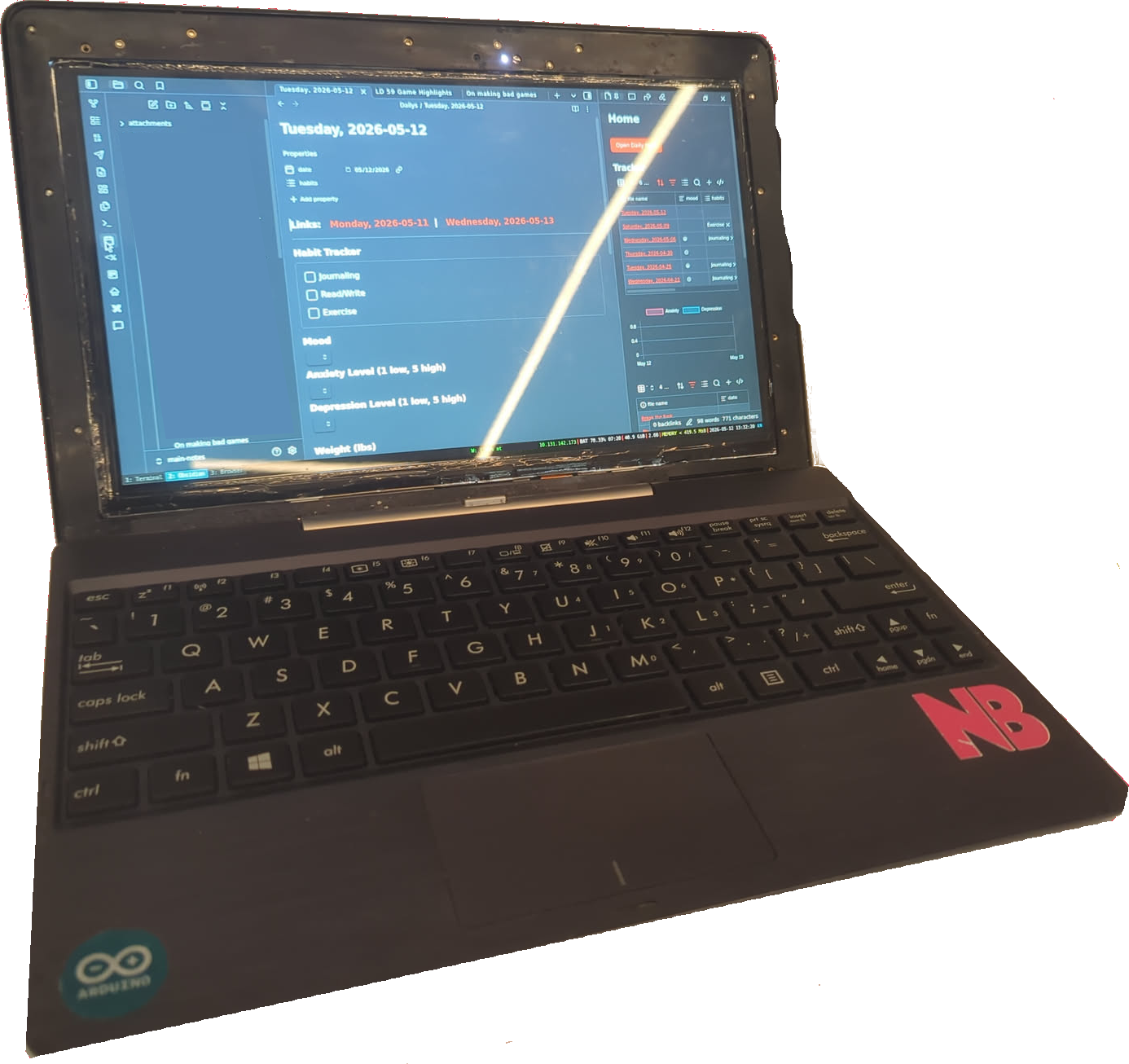
Isn't it beautiful? Yes, you may have noticed that the raw LCD display is exposed. The touchscreen panel/glass protective surface broke... twice. I replaced it 7 years ago, and then promptly broke it again. So, I am running the LCD panel raw.
To run the experiment, I will use Jankbook to be my primary method of sending email, making art, and writing stuff down.
Results
After several weeks of using Jankbook, these are my conclusions
| Writing (journaling, prose, essays) | 5 |
|---|---|
| Writing Code | 3 |
| General Web Browsing | 4 |
| Creativity tools | 3 |
I was pretty shocked, even though this was the outcome I was expecting. This piece of junk was older than my children and was still able to run a modern OS, display modern webpages, and be my daily driver despite having less RAM than my old phone.
Obsidian ran like a dream, and I could use tailscale to access my remote drive with all my notes with 0 issues.
Coding lost points due to the screen and keyboard size more so than the lack of power. I mostly write bash, python and Rust.
Browsing was fine, but I had to be mindful of the tabs. If I were to ever have more than 5, things got slow. It did force me to be more intentional with the tabs I did chose to keep open, and forced me to re-invest time in a good RSS feed.
Why it matters
I no longer have confidence that the mainstream tech products being made have the end user in mind. Enshittification already took software, and now with the AI bubble, it's eating hardware too. We can still operate our jobs and create new things using "outdated" tech just fine, and that is a very empowering realization. If we want to keep computing open and equitable, it's imperative that we not waste compute power, drive up consumer prices, and flood landfills with perfectly good equipment.